
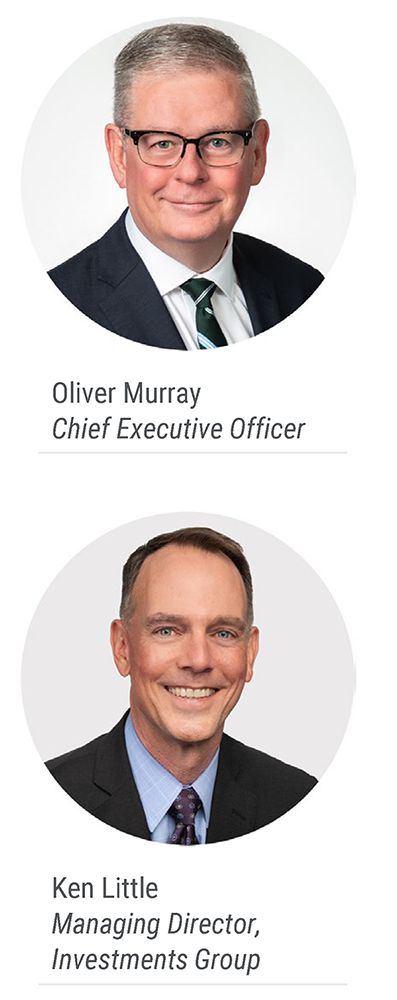
Oliver Murray and Ken Little are members of the firm's Executive Management Group, which oversees the firm's day-to-day operations and long-term strategic direction.
Matt Johnson:
Oliver, when you look back on 2025, which achievements best capture Brandes' progress and identity as a firm?
Oliver Murray:
Over the years, we've often talked about the long winter for value, the period after the Global Financial Crisis when market conditions weren't favorable for value investing. But throughout that extended period, we stayed true to our approach, believing that those conditions would eventually change.
Starting in late 2020, we saw the tide turn. And 2025 was really the year, I believe, when most allocators recognized Brandes once again as being a consistent and reliable implementer of value investing. Our performance and our asset gathering success in 2025 really cemented our long-term industry stature as a single style, boutique asset manager.
I think we've proven that we're an experienced and reliable practitioner of fundamental value investing, deserving of consideration by allocators around the world, and especially those who are looking for a tried and tested value manager.
Matt Johnson:
Ken, let's turn to you and talk about themes. Which investment themes stood out most in 2025?
Ken Little:
There were a couple of themes that were really prominent in 2025. First, for the better part of the last 10-plus years, the US market has dominated global equity markets, and that finally reversed in 2025. Both developed (MSCI EAFE Index) and emerging markets (MSCI Emerging Markets Index) strongly outperformed the US (S&P500) in 2025.
Oliver mentioned value outperformance has finally started to come back. That was particularly an international phenomenon in 2025, with international value stocks doing much better than their growth counterparts (MSCI EAFE Value vs. MACI EAFE Growth). In the US, value made a pretty strong comeback as well, although growth did outperform again last year (Russell 1000 Value vs Russell 1000), driven by the second big market theme. That was the continued focus on the growth of all things related to AI. Artificial Intelligence dominated the market narrative in the US throughout last year. This has mainly been a US phenomenon, but it's also impacted some non-US markets and selectively, a number of non-US technology stocks.
Matt Johnson:
Much of that conversation about AI and tech has been focused on how the US equity market has become increasingly concentrated. So, here’s a two-part question for you, Ken. What does that mean for portfolios, and is this phenomenon reminiscent of any previous time period?
Ken Little:
The AI theme has certainly led to a dramatic increase in concentration, particularly in the US markets. We've only seen this level of concentration a couple of times in the last fifty-plus years. The first time was the era of the so-called Nifty Fifty which peaked in 1972, just before our firm was founded in 1974. Measured by the percentage that the top ten stocks represented in the large cap indices, concentration levels were extremely high back then. The second time was a period that’s fresher in our memories: the tech stock bubble that peaked in 2000. Concentration was focused on the internet sector back then and once again rose to extreme levels. Driven by investors’ focus on AI-related stocks, today's market is even more concentrated than either of those two past periods, so we’re now at unprecedented levels.
Our portfolios remain diversified, but we still find some opportunities in the areas that are driving market concentration. We're not oblivious to opportunities in AI generation and technology implementation but there are ways to get exposure at much more attractive valuations than just those companies that are in the top ten by size in the indices.
Matt Johnson:
Thanks Ken. Oliver, performance for Brandes has been strong over these last couple of years, and we've seen a number of new clients investing in our strategies. In your estimation, what is leading to the renewed interest in Brandes?
Oliver Murray:
Referring to my earlier comments, Brandes has successfully come through that long winter for value. I’d focus on some of the themes that Ken spoke about. Many asset allocators have been overweight the US and underweight both non-US and value stocks. With the resurgence of value, these asset allocators may be reconsidering this underexposure and this has presented a real opportunity for these investors to look at Brandes.
We think that Brandes is well-positioned to help them build their allocations both to value and non-US stocks. As a result, we’ve seen very strong growth and net sales throughout 2025.
Matt Johnson:
Ken, there wasn’t much interest in value generally in the last few years prior to 2025, and there may have been a bit of a misunderstanding about Brandes' fundamental value approach. Could you please address that?
Ken Little:
Well, Matt, I think one aspect that's historically caused confusion in the marketplace for all value managers including ourselves, is the mistaken belief that value managers only buy turnaround situations and bargain stocks. That's certainly part of what we do, but we do a lot more than that. Some of that misconception may go back to the early writings of Benjamin Graham and his discussion about bargain issues and what he called cigar butt companies. That's part of what value managers do and it's part of what Graham wrote about, but it's by no means the only part of it.
Ben Graham also talked about the other end of the value spectrum, what he termed as primary companies: leading companies that are prominent, well-established, and well-capitalized. These types of investments are certainly very important to value managers. They’re certainly very important to us, and they’ve always been part of our portfolios.
Looking at our portfolios both today and across the decades, we've always had exposure across the value spectrum from bargain issues all the way up to primary companies. The sectors where you see those types of companies are certainly different today, but we've always had diversification across the value spectrum, providing broad exposure to value without being overly exposed to any one specific theme.
Our process has always been based on thorough fundamental research and our portfolio selections are driven by that process, taking into account the market environment and the opportunities available at the time. Accordingly, we're not trying to create portfolios that are balanced between bargain issues and primary issues in any targeted proportion; instead, I’d reemphasize that our portfolios have always been driven by our fundamental research stock selection process.
Matt Johnson:
Excellent, thank you. I have one final question for both of you. As we look forward to a new year in 2026, what are you most excited about?
Oliver Murray:
From the business side of things, I would say that we have strong momentum. Barring any significant market upheaval, we expect that this momentum will continue into 2026. We offer a compelling proposition for allocators who are looking beyond the US and who may be currently under-allocated to the value style.
Remember that we bring over fifty years of experience to our craft. We have seasoned, battle-tested analysts and portfolio managers. We are singularly focused on value investing, and we understand the clear role that we play in a client's portfolio. Clients can be confident that if they hire Brandes, they'll receive consistent and reliable exposure to value investing.
Matt Johnson:
Thank you, Oliver. Ken, what about you? What are you most excited about?
Ken Little:
First, it's important to acknowledge that market indices, particularly in the US, don't look cheap by historical standards. However, those extreme concentration levels we discussed are still providing us with good opportunities. For those, we need to drill down to the individual company and industry levels, where we can find companies that we believe are trading at very attractive valuation multiples. That's part of what makes us optimistic about the future.
Then, for the first time in years, we’re seeing the opportunity set broaden significantly, on both a sector and geographic basis. Some of the companies that we discuss in our investment committees today are from sectors where we haven’t seen good opportunities for a number of years. That’s an exciting development.
And lastly, and maybe most importantly, the fundamentals of the businesses we own in our portfolios are very solid, in our opinion. Those fundamentals, including balance sheet strength, cash flow generation, and growth profiles, may be some of the most attractive that I’ve seen in the last couple of decades. Putting all of those factors together, the valuation levels of companies, the broadening of the opportunity set, and the underlying fundamentals, makes us optimistic about the potential for future returns both on a relative and absolute basis.
Matt Johnson:
Thank you both for your thoughts and comments. For our audience, if you’d like to hear more about the Brandes approach to value investing in global equity and fixed income markets, please contact your Brandes representative or connect with us through www.Brandes.com.
The podcast of this discussion can be found at Podcasts.
Performance for all Brandes strategies can be found at Brandes.com. Past performance is not a guarantee of future results.
The MSCI EAFE Index with net dividends captures large and mid cap representation of developed market countries excluding the U.S. and Canada.
The MSCI EAFE Value Index with net dividends captures large and mid cap securities across developed market countries, excluding the United States and Canada, exhibiting value style characteristics, defined using book value to price, 12-month forward earnings to price, and dividend yield.
The MSCI EAFE Growth Index with gross dividends captures large and mid cap securities across developed market countries, excluding the United States and Canada, exhibiting growth style characteristics, defined using long-term forward earnings per share (EPS) growth rate, short-term forward EPS growth rate, current internal growth rate, long-term historical EPS growth trend, and long-term historical sales per share growth trend.
The MSCI Emerging Markets Index with net dividends captures large and mid cap representation of emerging market countries.
The Russell 1000 Index with gross dividends measures performance of the large cap segment of the U.S. equity universe.
The Russell 1000 Value Index with gross dividends measures performance of the large cap segment of the U.S. equity universe. Securities are categorized as growth or value based on their relative book-to-price ratios, historical sales growth, and expected earnings growth.
The S&P 500 Index with gross dividends measures equity performance of 500 of the top companies in leading industries of the U.S. economy.
Diversification does not assure a profit or protect against loss in a declining market.
One cannot invest directly in an index.
The information provided should not be considered a recommendation to purchase or sell any particular security. It should not be assumed that any security transactions, holdings, or sectors discussed were or will be profitable, or that the investment recommendations or decisions we make in the future will be profitable or will equal the investment performance discussed herein. Strategies discussed are subject to change at any time by the investment manager in its discretion due to market conditions or opportunities. Brandes Investment Partners does not guarantee that the information supplied is accurate, complete or timely, or make any warranties with regard to the results obtained from its use. Market conditions may impact performance. The performance results presented were achieved in particular market conditions which may not be repeated. Moreover, the current market volatility and uncertain regulatory environment may have a negative impact on future performance. The Brandes investment approach tends to result in portfolios that are materially different than their benchmarks with regard to characteristics such as risk, volatility, diversification and concentration. All investments carry a certain degree of risk including the possible loss of principal.
The foregoing reflects the thoughts and opinions of Brandes Investment Partners® exclusively and is subject to change without notice. Brandes Investment Partners® is a registered trademark of Brandes Investment Partners, L.P. in the United States and Canada.