
Dear Clients and Friends,
One of the most important questions a client can ask of an investment manager is not simply how decisions are made, but how the people making and informing those decisions are evaluated, rewarded, and motivated. Compensation is never a neutral design choice. If not well structured, it can encourage short-termism, internal competition, and behavior that is inconsistent with the promise made to clients. If structured well, it can reinforce the discipline, patience, and collaboration that long-term investing requires.
At Brandes, our promise to clients is straightforward: consistent and reliable exposure to value investing, with the goal of seeking long-term alpha over the relevant benchmarks and the fees our clients pay. We are purpose-built for that task. We seek to apply a disciplined, fundamental, valuation-driven process over time, recognizing that value investing will not be rewarded in every short-term period, but that a consistent process, applied through full market cycles, is the best way for us to help deliver long-term value to clients.
That promise shapes how we think about the compensation and incentive structure for our investment professionals. We do not think our analysts should be rewarded based on whether a particular stock they cover enters a portfolio, or how a hypothetical portfolio of their individual stock ideas might have performed. On the surface, those types of metrics can seem appealing. They appear objective, measurable, and reduce the impact of subjectivity. However, we believe it is too simple for the work we ask our analysts to do.

Our analysts are not salespeople for individual ideas. They are not asked to persuade our investment committees that a particular company should be included in the portfolio. Their role is to help the committees make the best possible judgment about the intrinsic value of a business. That requires deep research, balanced analysis, intellectual honesty, and a willingness to present both the opportunity and the risk. It also requires the analyst to be comfortable when their best contribution is to recommend caution.
At any point in time, one of our analysts’ key roles may be to help the investment committee avoid an entire industry or sector because the available opportunities are overvalued. In such a case, their contribution may not be visibly reflected in the portfolio holdings. Yet, in certain environments, it may be one of the most important contributors to long-term relative returns. A paper portfolio, or a compensation formula tied to an analyst's own selections, would have difficulty recognizing that value. Worse, it could, in our opinion, encourage the wrong behavior by rewarding advocacy over judgment.
For the same reason, we are not convinced of the idea that analysts should build notional portfolios so that we can track the performance of their picks. We understand the allure of that approach. It provides a number. It creates apparent accountability. But it also risks confusing the analyst role with that of the investment committees, and it can create incentives that are inconsistent with a collaborative, valuation-driven process. At Brandes, our investment committees are responsible for making the final decisions on intrinsic value estimates and portfolio construction, while the analysts are responsible for producing the research, insight, and perspective that helps the committees make the optimal stock selection and allocation.
This distinction matters because, in our view, successful long-term investing is not only a quantitative exercise. It depends on temperament, patience, curiosity, humility, courage, flexibility, and critical thinking. It requires investors to remain disciplined when markets are rewarding others for doing something different. It requires a culture where people are willing to challenge each other, change their minds when the evidence changes, and accept that sometimes the best investment decision is to do nothing.
Accordingly, we evaluate analysts qualitatively and comprehensively. Our annual 360-degree review process considers the quality of an analyst's research, the rigor of the underlying analysis, productivity and timeliness, adherence to our value philosophy, collaboration, and contribution to the investment decision-making process. In doing so, the goal is not to avoid accountability. The goal is to ensure that accountability is aligned with the work that drives long-term results for clients.
We believe that our compensation approach also reinforces long-term economic alignment. Many of our analysts and investment committee members participate in the economics of the firm through long-term equity-like arrangements (phantom equity) or as limited partners of the firm’s parent company. Equity investment committee members are also required to make meaningful personal investments in the strategies they manage. This helps ensure that they are personally invested alongside our clients. When you put all of this together, our people are aligned with the long-term success of the firm and, by extension, the clients whose assets they manage.
External discussions of best practice in investment management compensation often emphasize long-term alignment, transparency, avoidance of incentives that encourage excessive risk-taking, and attention to conflicts of interest. We agree with those principles. We believe incentive structures should reinforce the behaviors that serve clients over time. For a value manager like Brandes, that means resisting short-term formulas that could encourage people to promote ideas, chase recent performance, or drift from the discipline that clients hired us to provide.
Ultimately, the clearest test of whether our system is working is whether we are delivering on our promise to our clients. Are we providing consistent exposure to value investing? Are our strategies delivering performance over time relative to value benchmarks and relevant peers? Are we retaining and attracting the investment talent required to sustain the process? If the answer to those questions is yes, then our compensation and evaluation framework is doing what it was designed to do.
We believe the evidence is encouraging. Our approach has remained broadly consistent for many years, and clients continue to entrust us with capital. This year alone, existing and new clients have entrusted us with more than $6.8 billion in new capital as of August 31, 2026. Just as importantly, when prospective clients conduct due diligence on Brandes, I am often asked to describe what is distinctive about our culture and how we assess whether that culture is working. Culture can be difficult to measure precisely, but retention is one tangible indicator. In my view, our ability to retain investment talent over time points to the strength of our culture and the effectiveness of our compensation and incentives program.
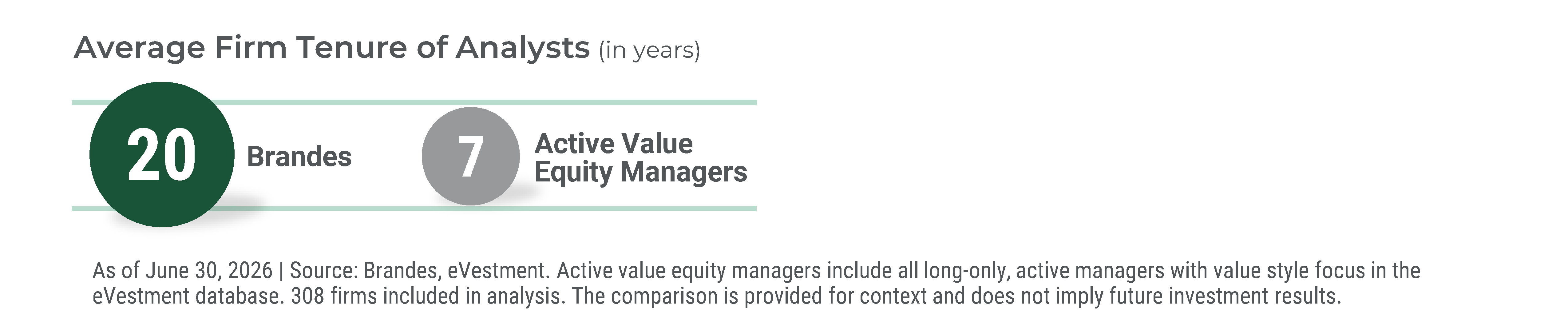
I would also draw your attention to the Average Firm Tenure of Analysts chart below. Brandes analysts have an average firm tenure of 20 years, compared to only 7 years for active value managers in the eVestment database. We believe this difference matters. Successful value investing requires patience, discipline, and the experience that comes from evaluating businesses and navigating multiple market cycles. The continuity and accumulated knowledge of a long-tenured research team can be a significant competitive advantage for our clients. Equally important, I do not believe an investment firm can achieve this level of retention without a healthy culture, strong alignment of interests, and a compensation system that supports long-term collaboration and professional fulfillment.
No one compensation structure is right for every investment manager. A firm built around individual portfolio managers running concentrated portfolios might reasonably choose an alternative model. Brandes is different. We are an independent boutique, dedicated value manager with more than five decades of experience applying a team-based, research-driven process. Our compensation approach reflects that identity.
In our judgment, we have struck the right balance when it comes to our compensation structure and alignment of interests. We have designed a system that rewards research quality, long-term thinking, collaboration, intellectual honesty, and alignment with clients. We believe it supports the culture and process required to deliver what clients have asked us to deliver: consistent and reliable exposure to value investing, with the goal of seeking long-term alpha over the relevant benchmarks and the fees our clients pay.
Thank you for your continued trust.
Sincerely,
Oliver MurrayThis material is intended for informational purposes only. The information provided should not be considered a recommendation to purchase or sell any particular security. The Brandes investment approach tends to result in portfolios that are materially different than their benchmarks with regard to characteristics such as risk, volatility, diversification, and concentration. All investments carry a certain degree of risk including the possible loss of principal.
Past performance is not a guarantee of future results.
The foregoing reflects the thoughts and opinions of Brandes Investment Partners® exclusively and is subject to change without notice. Brandes Investment Partners® is a registered trademark of Brandes Investment Partners, L.P. in the United States and Canada.